
Targeted SEO Terms for Packaging Suppliers: Keywords That Attract Better B2B Buyers
Generic keywords related to packaging manufacturers or custom packaging will attract too varied a group of visitors, including curious consumers, students doing research, and competitors. However, they will not pull in B2B buyers with a spec sheet and a budget. To attract better B2B buyers, your brand needs to use targeted SEO terms that offer \[…\]
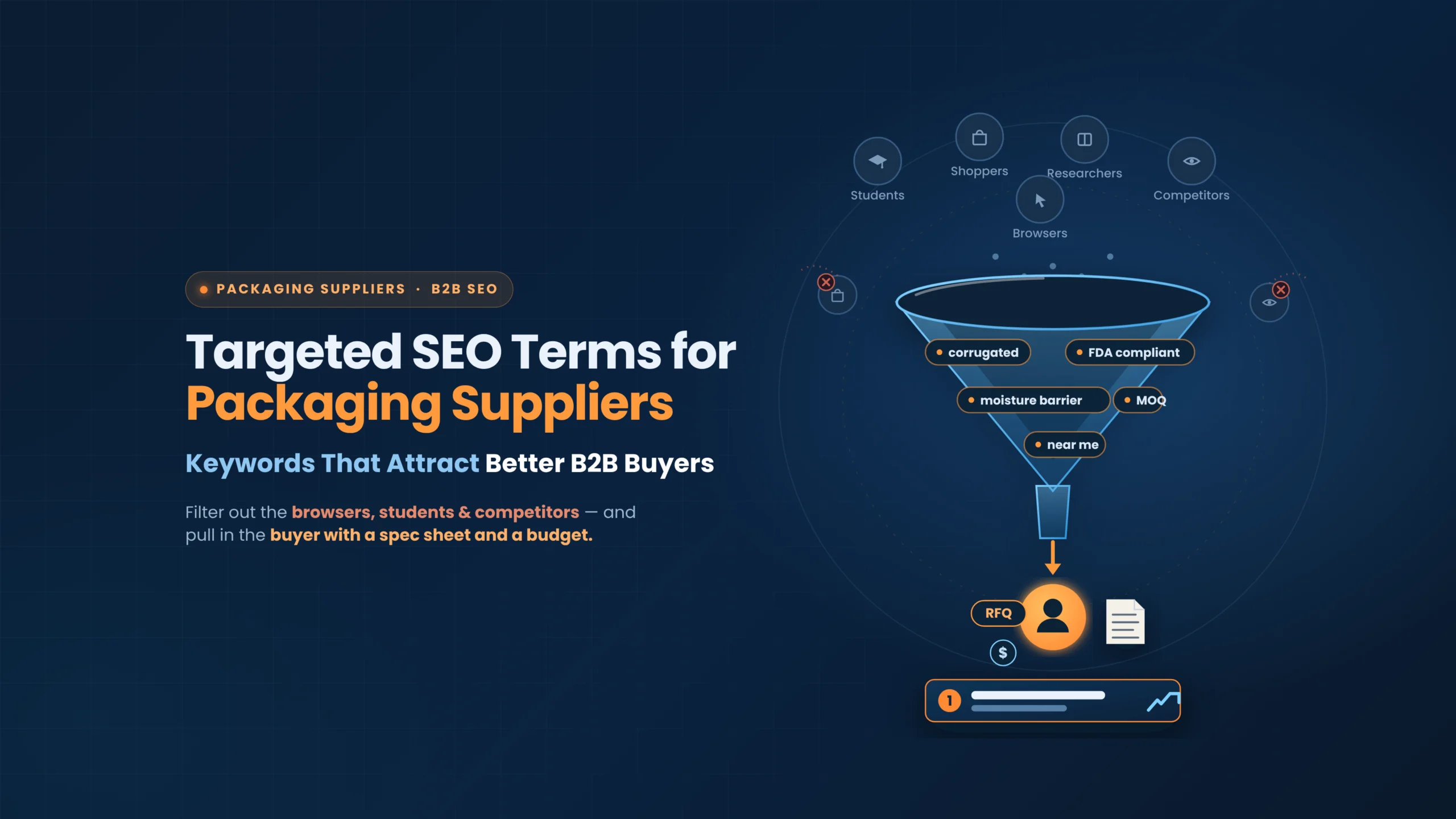
Generic keywords related to packaging manufacturers or custom packaging will attract too varied a group of visitors, including curious consumers, students doing research, and competitors. However, they will not pull in B2B buyers with a spec sheet and a budget. To attract better B2B buyers, your brand needs to use targeted SEO terms that offer specificity at every layer.
Targeted SEO Terms Packaging Suppliers Should Prioritize
Packaging Type Keywords
Packaging type keywords should focus on corrugated packaging, folding cartons, flexible packaging, industrial packaging, e-commerce packaging, and labels. They should map keyword specificity to how close someone is to issuing a request for quote (RFQ).
Application-Specific Packaging Keywords
Certain packaging SEO terms should also be organized around what the packaging needs to do. They are targeting searches where the buyer knows their functional requirement but not the exact product category. Such application-specific keywords include “tamper evident,” “moisture barrier,” and “shock absorbing.”
Industry-Specific Packaging Keywords
Many SEO terms should also be segmented by industry, which many packaging supplier sites fail to do. The most relevant industries include cosmetics, pharmaceuticals, food and beverage, industrial/manufacturing, luxury, and e-commerce.
Long-Tail and Quote-Ready Searches
Certain long-tail keywords are designed for buyers who already know exactly what they want and are ready to request a quote. Such keywords might include the number of units, free samples, and other keywords that signal a buyer is ready to act.
Local and Regional Packaging Keywords
Local and regional intent also matters when it comes to shipping cost sensitivity, buyers wanting shorter lead times, and some companies preferring domestic or regional suppliers for supply chain resilience. Such keywords involve specifically naming certain cities, states, metropolitan areas, and regions.
Why Generic “Packaging Manufacturer” SEO Often Misses the Mark
Broad Packaging Terms Attract Mixed Intent
Broad packaging terms attract an overly large and mixed group of visits, including students, competitors, and consumers. The objective should be to only attract real buyers.
Packaging Type Differentiation Requires Distinct SEO Strategies
Each packaging type has a genuinely different buyer journey and vocabulary, so distinct SEO strategies make the most sense. Trying to rank one page for all packaging types will likely result in ranking for none of them.
B2B Buyers Search Differently Than B2C Shoppers
Generic SEO terms also don’t work because B2B buyers search with specs (e.g., material, compliance standard, MOQ, industry) baked into the query. B2C shoppers will use more generic terms and search by use case or price.
Relevance Matters More Than Search Volume
Search volume can be very misleading when it is not connected to actual conversion. A page that ranks pretty well for targeted SEO terms with 100 searches that converts is much more valuable than a generic packaging manufacturer that has thousands of visitors but never converts.
Packaging Type Keywords by Buyer Intent
Corrugated Packaging Keywords
Corrugated packaging keywords are generally split up into three buyer tiers: volume/commodity buyers, spec-driven researchers, and format-driven buyers. There should be separate landing pages or at least clearly separated sections with targeted keywords for each buyer type.
Folding Carton Keywords
Folding carton keywords tend to favor regularly-industry procurement or marketing buyers. The former is focused on compliance terms like “FDA compliant” while the latter is focused on print quality and MOQ terms.
Flexible Packaging Keywords
Flexible packaging keywords have shifted toward sustainability qualifiers, which means that buyers are researching recyclable and compostable materials alongside format terms.
Label Manufacturing Keywords
Buyer intent around label manufacturing keywords tends to be highly application-specific. They are searched with substrate, adhesive type, and/or end-use attached.
Industrial Packaging Keywords
Industrial buyers search using very literal and spec-first language, which focuses on dimensions, weight capacity, and container type. Procurement or logistics staff will likely search for keywords seen on a technical spec sheet.
E-Commerce Packaging Keywords
E-commerce packaging keywords revolve around DTC brand owners rather than dedicated procurement staff, because they search with brand and unboxing-experience language mixed in with practical shipping terms.
Industry-Specific SEO Terms for Packaging Companies
Cosmetic Packaging
Cosmetic packaging SEO terms tend to revolve around both aesthetics and minimum order quantity (MOQ).
Food and Beverage Packaging
Food and beverage packaging SEO terms tend to focus on compliance terms around FDA approval, food-grade packaging, direct food contact, FSMA, etc.
Pharmaceutical Packaging
Pharmaceutical packaging SEO terms tend to focus on compliance-first vocabulary, because your target buyers are procurement managers and QA people.
Industrial and Manufacturing Packaging
Industrial/manufacturing packaging SEO terms are usually very technical and literal searches (e.g., “heavy equipment packaging supplier,” “export crating manufacturer ISPM 15”).
Luxury Packaging
Luxury packaging SEO terms tend to revolve around brand and finish quality terms. Buyers are looking for keywords like “soft-touch” or “foil stamp” in addition to basic luxury terminology.
How to Find High-Intent Packaging Keywords
Focus on the Searches Buyers Actually Make
The first step to finding high-intent packaging keywords is to find the searches your target buyers actually make. Look at RFQ forms, discovery call notes, and email inquiries to find the phrases that buyers use. For example, one buyer might search for “boxes that won’t collapse under heavy weight in a truck” when the official term would be “high compression strength corrugated.” Both instances need to be covered so that internal buyer language and external site language match up.
Use Competitive Analysis to Find Keyword Gaps
Instead of starting from scratch, you should look at which specific pages your direct competitors rank for that you don’t have an equivalent page for. This process will quickly surface keyword gaps. Competitor domain analysis can reveal which long-tail and industry-specific or application-specific terms are sending traffic to a competitor’s site.
Match Keywords to Buyer Problems and Applications
Many buyers search by the problem that they are solving before they have settled on the product category that solves it, so it is best to match keywords to specific problems and applications. For each core packaging type and industry vertical you serve, list underlying problems that can be solved by type of packaging.
Look for Terms That Indicate Quote or Supplier Intent
When you are prioritizing long-tail terms, you should keep in mind keywords that separate someone doing research from someone ready to request a quote. “Supplier,” “manufacturer,” “wholesale,” “near me,” and “minimum order” are some of the most popular keywords to keep in mind.


