How to Get Your Engineering Firm on Google's First Page
In the digital age, visibility is king. When buyers research potential engineering firms, they often find what they need on the first results page; it’s up to you to get your firm there. This is done with search engine optimization (SEO) tactics, which help structure web content for search engine visibility.
In the digital age, visibility is king. When buyers research potential engineering firms, they often find what they need on the first results page; it’s up to you to get your firm there. This is done with search engine optimization (SEO) tactics, which help structure web content for search engine visibility.
Rather than compete for big queries, most engineering firms target searches that more accurately reflect a firm’s specific strengths. Here, we’ll walk through how to find your niche, work it into your content, and improve other parts of your site to get your company on Google’s first page.
Make Sure Google Can Find Your Website
Google’s bots are consistently crawling the web, but there’s no reason to wait for that process to catch up to your site. The first step in the SEO process is to register with Google Search Console by verifying yourself as a domain administrator. Then, you can create an XML sitemap, which is a structured breakdown of your content, and submit it to Google. This puts your site in front of Google’s crawlers and makes it easier for them to traverse.
After Google crawls a site, it moves to indexing. This is where SEO is primarily tested; bots will assess crawled pages and grade them on technical factors before listing them on Google. It’s important to fix any issues that emerge in either stage, as they determine how Google sees your site’s content.
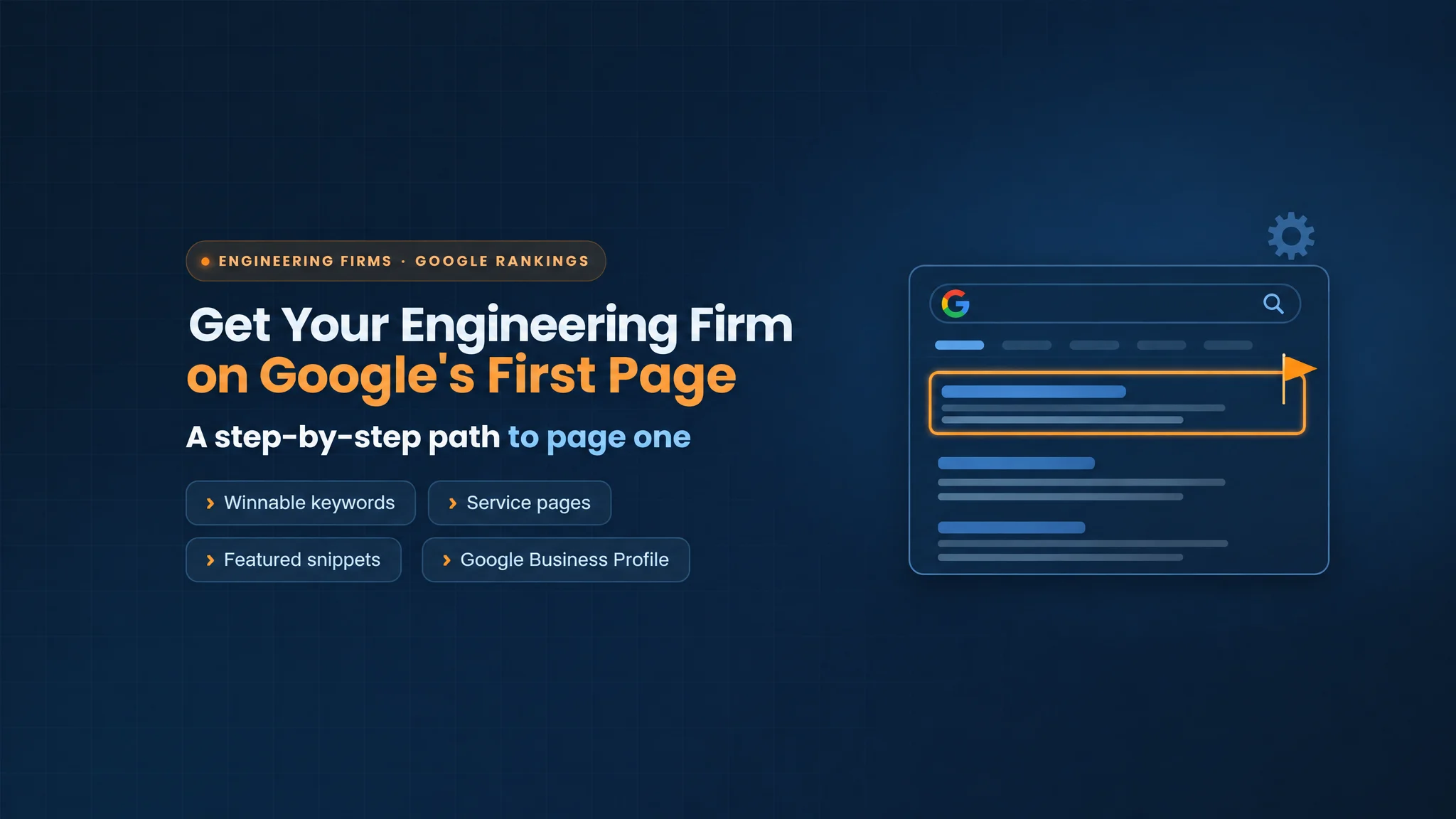
Step-by-Step: How to Rank on Page One
1. Pick keywords you can realistically win
If they don’t already have it, any single engineering firm probably won’t win the top ranking for “best engineering firm.” Instead of thinking big, think specific; what region does your firm serve? What unique services or capabilities do you provide? Do you have any sought-after expertise or certifications? Finding the search keywords that match these realistic, tailored questions will provide the core of your SEO strategy.
2. Match search intent with the right page type
Clients will come to your site with different goals as they move through the buying process. Sites should cover informational, navigational, commercial, and buy-ready intent. Publishing unique content for each stage ensures you address each audience's needs. For engineering firms, this might include answering technical questions to build authority, providing clear address info, publishing methodologies, and proof-backed service pages with contacts.
3. Build strong service and industry pages
Pages that clearly show your offered services and targeted industries show bots that your business is well-developed, transparent, and experienced. Providing this info up front gives indexing bots a clearer picture of what your company does, making your site a more compelling candidate for top rankings on relevant searches.
4. Optimize on-page elements (title, H1, meta, headers, URLs)
When a web page uses structural HTML elements properly, it’s easier for both bots and clients to read. These elements also contain valuable information for search pages and carry specific optimal character lengths.
- Title tag: The page’s title on result pages. It should be between 50-60 characters. Search engines prefer titles that open with a user-language keyword like “Structural Engineering Firm in Denver.”
- H1: The page’s title on the page itself. They follow many of the same rules as title tags. An H1 should target the same keyword as its page’s title, but be worded differently to sound more natural.
- Meta description: The blurb that sits under the clickable link on a result page. These should be between 150-160 characters, and should use active language that encourages clicks.
- Headers: Using the proper header hierarchy, rather than skipping tiers, makes a page more machine-readable. Subheadings are also an important place to seed secondary keywords.
- URLs: A URL that’s lowercase, short, simple, and broken up by keywords is the best for both humans and bots. Avoid special characters, and be sure to include keywords.
5. Publish helpful content that answers buyer questions
Original, factual, and helpful content is a prominent trust signal; search engines will reward content that’s genuinely informative and helpful. Engineering firms can answer common jobsite questions, provide equipment specifications, and detail permitting requirements.
Informational content will also boost visibility for AI Overviews. Content structured to answer a specific query is more likely to be used as an answer or citation for that query. This is an emerging form of valuable visibility, often called answer engine optimization (or AEO).
6. Target featured snippets and People Also Ask
Featured snippets (the highlighted-line top-spot answers that Google favored before introducing AI Overviews) are usually drawn from first-page rankings, requiring successful SEO. From there, content can be formatted to answer the three types of snippets. Answers should always be the first thing under a heading.
- Paragraphs (definitions, facts): Build in a specific 40-60 character segment that clearly answers the question immediately underneath an H2 or H3.
- Numbered lists (guides, rankings): Use clean ordered list HTML tags (
<ol>) and keep entries concise. - Bulleted lists and tables (comparisons, options, features): Well-structured
<ul>tags and clean table formatting can trigger a “see more” button in the snippet, which boosts click-through rates.
People Also Ask slots can be targeted with real-world FAQs. Use third-party tools to find linked queries by accessing existing also-ask trees. Then, using the same clean snippet logic, answer the also-ask query underneath a heading that mirrors the question’s language. For engineering firms, these queries might include related services, pricing, or competitors.
7. Improve page speed and mobile experience
Site performance, customer experience, and SEO are all uniquely interconnected for engineering firms. Mobile compatibility matters because Google primarily reads the mobile version, and search engines grade site performance as an important trust signal. Clients expect vendors to have a generally high degree of technical skill, and often view website construction as part of that skill set.
8. Show E-E-A-T with credentials, projects, and case studies
E-E-A-T is a framework used by Google’s human raters to improve their algorithm.
- Experience: Does the content’s creator have relevant experience with the topic?
- How to build: Case studies, methodology reviews, outcomes
- Expertise: Does the content’s creator possess necessary skills and knowledge?
- How to build: Content answering technical questions with named expert authors
- Authoritativeness: Is the content’s creator a respected, backed source on the topic?
- How to build: Visible certifications, backlinks from prominent sources
- Trustworthiness: Is the page safe, honest, and accurate?
- How to build: Commitment to safety, well-maintained backend, regular content refreshes
9. Earn backlinks from associations, partners, and trade media
Backlinks are references to your site published on outside sources. They demonstrate that your firm has connections to other entities in the industry. Quality matters more than quantity for backlinks; one or two on high-profile engineering association sites or trade media matters more than fifty links on low-traffic sites. Paid features, guest articles, and high-quality content that others cite are all ways to earn backlinks.
10. Optimize your Google Business Profile and reviews
Each piece of info you add to your Google Business Profile will pay off. Google rewards listings that provide detailed information on their business, going beyond the basics to include things like holiday hours, business categories, and photos. Engineering firms can add contact information and hours, team photos, and other info to fill out their profiles.
Reviews are another important trust signal. Regularly replying to reviews shows Google that you’re engaged with your customers, which boosts rankings. Google also prefers a steady flow of reviews over huge spikes, so it's best to request reviews regularly.
How Long Does It Take to Reach Page One?
A new website can reach the first page within 3-6 months at the earliest, if it consistently applies good SEO techniques. Rankings are unstable; a first-page ranking can appear and feel like a victory, only to disappear the next week, but that isn’t a signal of quality. Google is still calibrating where your site sits. Vigilantly maintaining SEO practices across the site over time is the best way to increase rankings.
Track Progress and Keep Improving
It’s important to keep monitoring performance in order to guide future SEO adjustments. Rankings, impressions, clicks, and incoming leads all signal how visible your firm is online. Content ranked on Google’s second page deserves special attention; these pages are on the verge of first-page placement, but don’t have enough material. Updating and expanding these pages pushes them across the finish line and gets your firm the attention it deserves.