10 SEO Principles Every Engineering Firm Marketer Needs to Know
One of the most important ways to grow your engineering firm is ensuring that your business is visible at a crucial point for potential clients – when they are researching products and services. In this industry, buyers rely heavily on expertise and knowledge before deciding to purchase. To generate leads, you need a strong online presence to put your services in front of the right buyers. Otherwise, your firm can lose leads to competitors that rank higher in search results.
One of the most important ways to grow your engineering firm is ensuring that your business is visible at a crucial point for potential clients – when they are researching products and services. In this industry, buyers rely heavily on expertise and knowledge before deciding to purchase. To generate leads, you need a strong online presence to put your services in front of the right buyers. Otherwise, your firm can lose leads to competitors that rank higher in search results.
If you are looking for different solutions for your engineering SEO or looking for ways to improve your SEO success, this is the place for you. Here, we'll cover 10 SEO principles you can use to gain clients, keep the ones you have, and sustain growth.
What Are SEO Principles?
Search engine optimization (SEO) is the practice of optimizing your website to increase its visibility on search engines like Google. SEO breaks down into three main pillars: technical SEO, on-page SEO and off-page SEO. Each type of SEO focuses on a different aspect of your website’s performance and visibility, ensuring a comprehensive approach to increasing your site’s SEO rankings.
- Technical SEO: This addresses the backend elements of your website, such as site speed, mobile-friendliness, and indexing.
- On-Page SEO: This focuses on the aspects of your website surrounding your page's content and structure, including keyword usage, meta descriptions, and internal linking.
- Off-Page SEO: This covers activities outside your website that boost its authority and reputation. This includes building high-quality backlinks, social media engagement, and online PR.
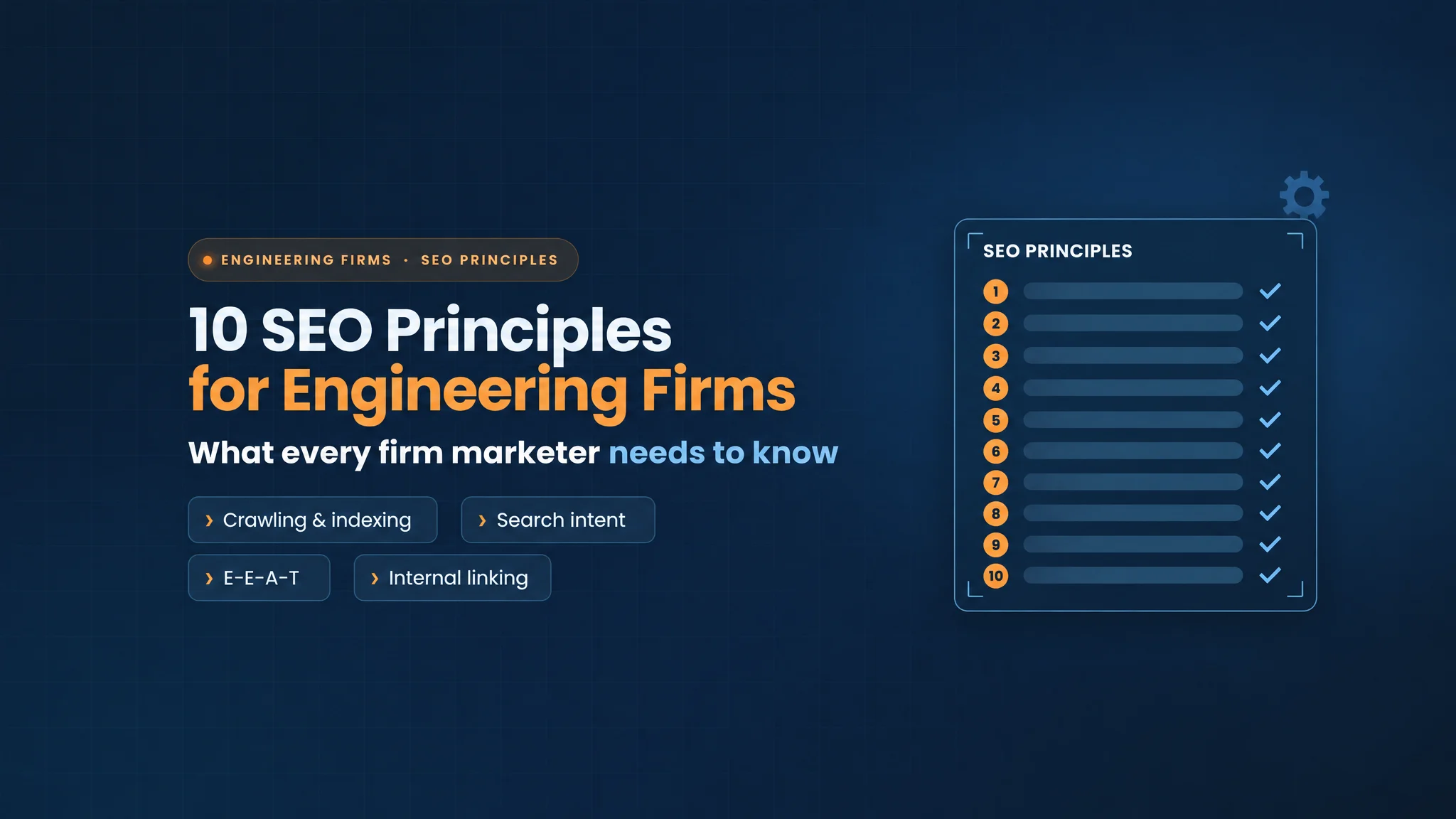
10 SEO Principles for Engineering Firms
1. Crawling and Indexing
One way to optimize for technical SEO is to ensure search engines can find every service and project page. To do this, improve your pages' crawlability. This involves setting up robots.txt files to guide search engine bots and creating XML sitemaps to help them find your content.
2. Site Performance
Fast, mobile-friendly pages for clients researching your firm are another important aspect of improving your website’s infrastructure. Faster loading times improve user experience and search engine rankings, and a mobile-friendly site helps potential clients who may be on mobile devices without access to a desktop computer.
3. Structured Data
Structured data refers to a kind of script tag that you can add to your website’s HTML. Implementing structured data helps web crawlers quickly understand your site's most important content.
Some key script tags include:
- Organization: Adding organization structured data to your homepage helps search engines better understand administrative details, such as disambiguating your organization from others, and can influence visual elements in search results.
- Service: This type is used to describe the services provided by an organization
- LocalBusiness: With Local Business structured data, you can provide information about business hours, reviews, and more.
4. Search Intent
The gap between how marketers describe a service and how engineers search for it is often a real growth opportunity. Engineering buyers use highly specific, problem-driven queries. Unlike consumer search behavior, these queries are often long-tail, specification-heavy, and tied to compliance requirements.
For instance, engineers typically use technical phrases such as “ISO 9001 CNC machining in Dallas” when making searches. They also often ask solution-driven questions instead of brand-driven searches. To get your firm in front of buyers, match what clients want when they research, compare, or hire engineers.
5. Keyword Research
As mentioned earlier, engineers are more precise and detailed than other consumers, so your keyword research strategy should match how engineers and procurement officials describe technologies, problems, and deliverables.
Keyword formats your engineering firm should target include:
- Service-based keywords: “mechanical engineering consulting,” “civil engineering design services.”
- Project-type keywords: “CFD simulation services,” “structural load analysis.”
- Compliance keywords: “ASME pressure vessel design, ”ISO 29845:2011 engineering documentation.”
- Location-based keywords: “engineering companies in California,” “structural engineering firm in Denver.”
6. E-E-A-T Principles
Search engines like Google prioritize helpful, reliable information that’s created to benefit people, not content that’s created to manipulate search engine rankings. Search engines like Google prioritize experience, expertise, authoritativeness, and trust. This means precise, knowledgeable content will outperform thin, generalized copy, especially in specialized sectors.
Content you should focus on to display your experience, expertise, authority, and trustworthiness includes:
- Case Studies: Providing genuine challenges with specific outcomes can show concrete results instead of vague success stories.
- Comparison and Specification Content: You can provide content for buyers evaluating whether to select your firm’s services by showing how you compare to others.
- Thought Leadership: Articles from your experts and leaders about industry-specific challenges and how you deal with them can build authority with both search engines and the professionals reading them.
7. Internal Linking
Internal links are hyperlinks that connect one page of your website to another page on the same domain. They guide both users and search engines through your site. For instance, a link from your “Blog” page to your “Contact” page is an internal link.
The SEO benefit of internal linking is strengthening your topical authority. When your internal links connect to related pages within a topical cluster, they show search engines that your website covers the subject in depth. This helps algorithms understand that your content is both relevant and reliable within that area.
8. Backlinks
High-quality backlinks can boost your ranking and improve visibility in search engines by adding more external links pointing to your website. Backlinks act as a vote of confidence from other reputable websites. Search engines view the quality and quantity of external links as a sign of authority from other websites. Backlinks may also drive more visitors to your page through referral traffic.
9. Local and Brand Citations
For most engineering firms, local SEO is the single highest-ROI activity. This means optimizing your Google Business Profile with accurate service descriptions, correct categories, and regular updates to capture potential clients in your area. Another way to boost local SEO is through local or brand mentions that link back to your page.
Also, make sure reviews and testimonials are visible on your website and Google Business Profile. This matters because many private developers, building owners, and corporate clients check them before deciding.
10. AI Visibility: SEO For the New Age
As engineers turn to AI tools such as ChatGPT, a strong SEO foundation can also improve your visibility in AI searches. AI tools prioritize many of the same principles as traditional SEO, and improving your SEO will increase your brand's prominence when engineers look for solutions. For example, authoritative backlinks signal credibility to both Google’s algorithm and AI platforms’ source selection systems. Another overlap is structured data, because machine-readable information can boost accuracy on both platforms.
Conclusion
SEO is a powerful, cost-effective strategy for engineering firms looking to enhance their online visibility, attract more clients, and drive business growth. But to succeed in engineering SEO, firms must move beyond generic strategies. By understanding your clients and building your marketing strategies around principles such as client intent and content optimization to build trust with engineering buyers, your firm can attract more clients and achieve sustained success in the digital landscape.
If you would like to explore what an SEO strategy built around your engineering expertise could look like and speak to engineers without compromising on accuracy, get in touch with Zupo.