Understanding AI Citations for Engineering Firms: How They Work and How to Optimize for Them
Getting cited by AI search engines (ChatGPT, Perplexity, Google AI Overviews, Claude) is an important goal for any engineering firm that wants to improve its search presence. However, AI citations require generative engine optimization (GEO): making content easy for LLMs to find, parse, and trust.
Getting cited by AI search engines (ChatGPT, Perplexity, Google AI Overviews, Claude) is an important goal for any engineering firm that wants to improve its search presence. However, AI citations require generative engine optimization (GEO): making content easy for LLMs to find, parse, and trust.
Like so many users in other industries, engineering clients now ask AI tools to shortlist firms. This means that firms have to make content that is easily digested and understood by AI-powered search engines on top of being useful to human readers.
In this guide, we explain what an AI citation is, how AI search engines choose what to cite, and how engineering firms can optimize their own content to better appear in AI-generated answers.
What Is an AI Citation?
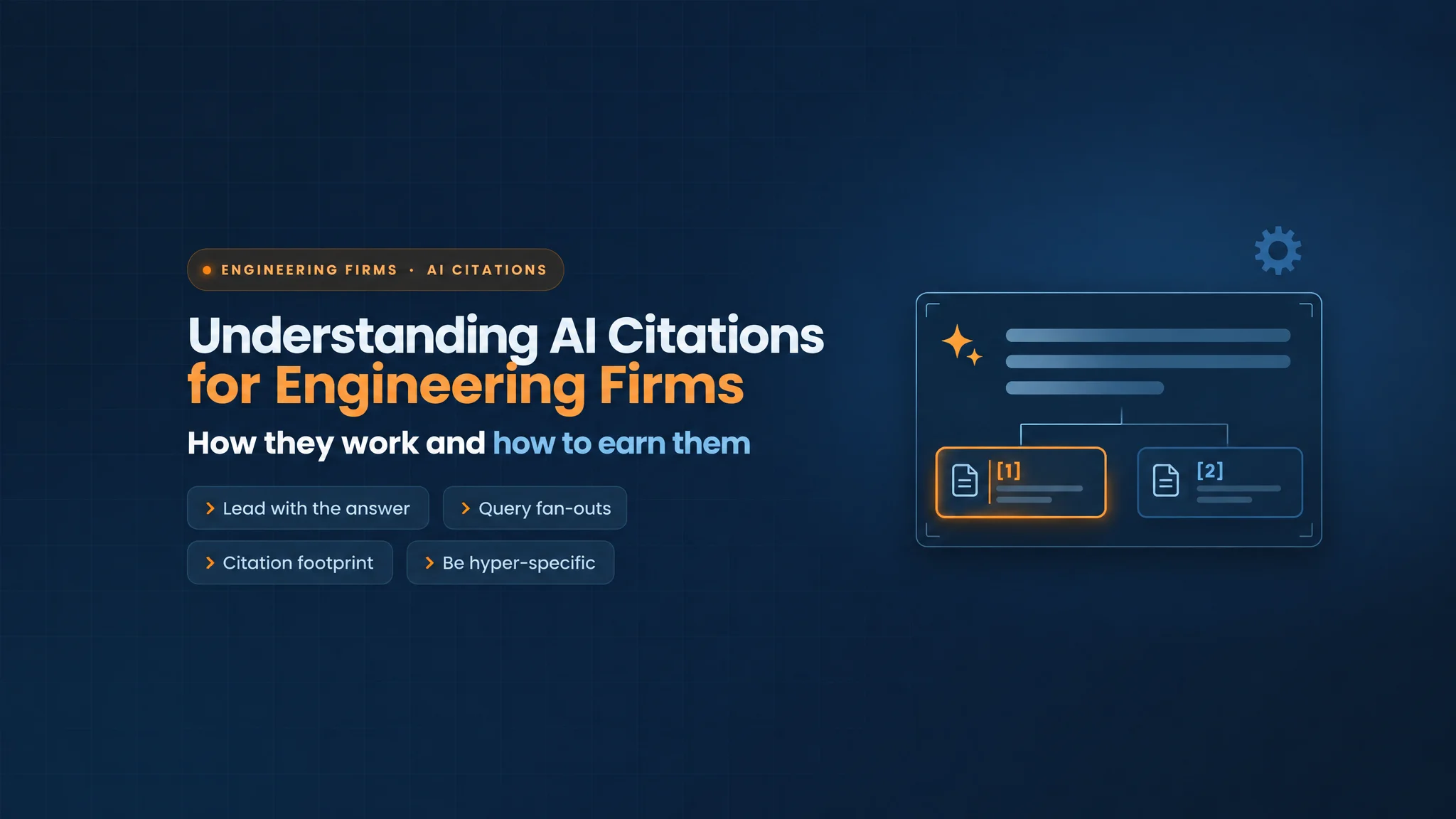
An AI citation is when an AI-powered search engine or tool references your web page and includes a hyperlink or source attribution to your site. This is a great sign that your SEO and GEO tactics are already starting to work. However, answer inclusion is when your firm is specifically named in an AI-generated answer. That is the real goal and what will set you apart from your competitors.
How AI Search Engines Choose What to Cite
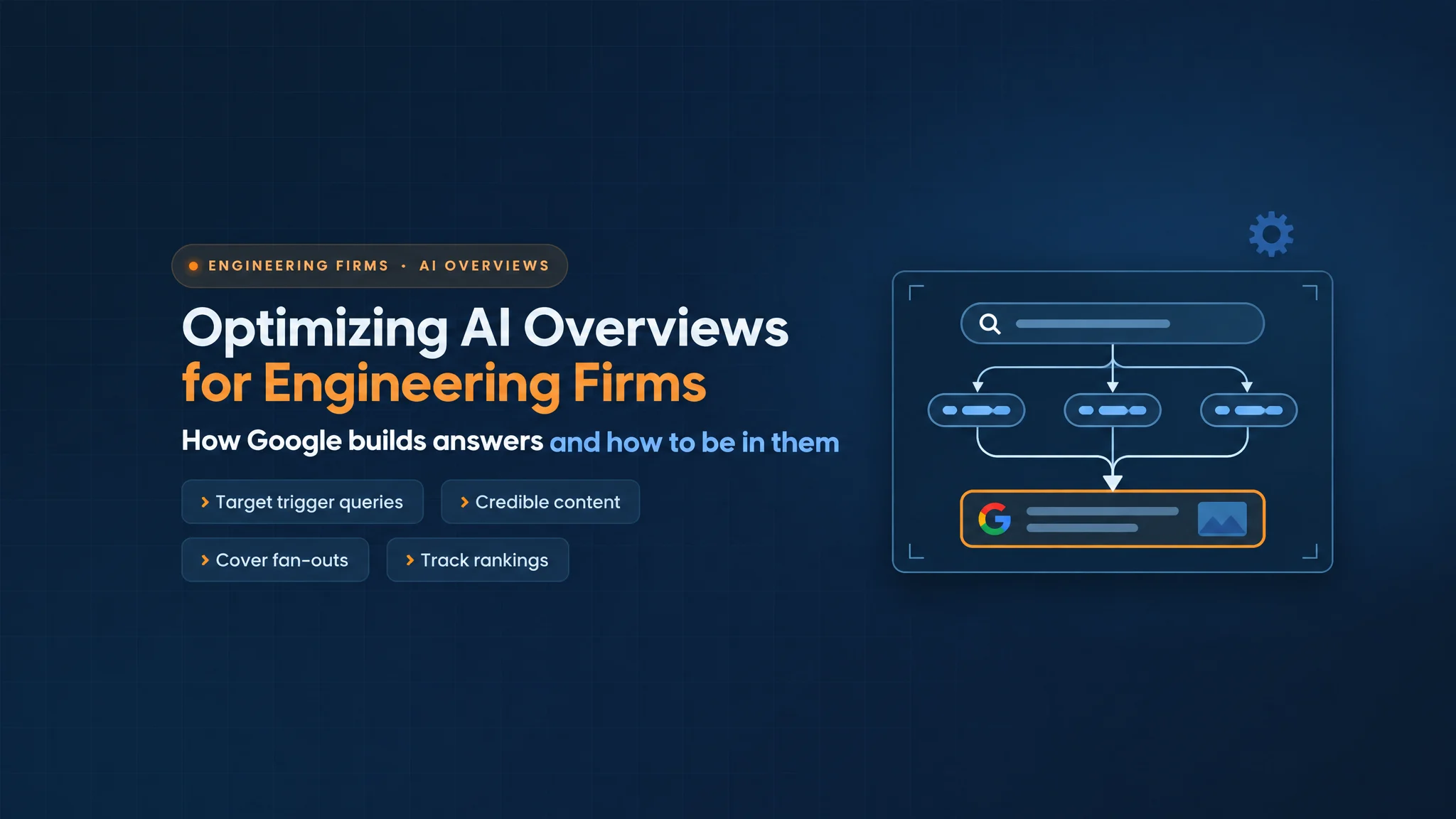
AI-powered search engines operate through a multi-step pipeline to decide which engineer firms to cite or include in generated answers. When a user types a broad prompt like "best structural engineering firms in Texas," the AI tool expands it into a “fan-out” of sub-queries (e.g., "top structural engineering firms Houston," "structural engineering firm reviews").
Once that query fan-out is complete, the engine pulls high-ranking web pages, directories, and various trusted industry publications that match all of those queries and subqueries. The large language model (LLM) reads the top-performing snippets, extracts relevant factual data, and cross-referencing the claims it discovers before building a consolidated and conversational answer to the original user query.
Structure Content for Direct Extraction
LLMs are trying to get clear and direct answers to user queries, which means they are looking for high-density passages that are easy to understand and extract.
Lead with the Answer
Open every major section or page with a direct 1-2 sentence summary that immediately answers the core question at hand. This structure makes it easier for both humans and machines to find what they are most looking for.
Use Question-Based Subheadings
Write headings (H2s and H3s) that mimic the real questions that your potential clients ask when looking for a new engineering firm (e.g., “How long does a structural assessment take?"). It should somewhat closely follow the actual phrasing that your ideal client would use.
Use Clean Formatting
Break up dense engineering copy with bulleted lists, step-by-step processes, and comparison tables for technical specs, loads, or zoning capacities. Quality remains the first priority, but readability and clean formatting should also be kept in mind.
Include Original Data and Quotes
Publish original data and quotes that generic AI crawlers will not be able to find elsewhere. Focus on hard numbers, project timelines, square-footage costs, or insights from your licensed Professional Engineers (PE).
Win Traditional Search
GEO is built on top of traditional SEO, not as a replacement for it. If your site is not ranking on page one of standard search engines, AI models are less likely to retrieve your firm’s content.
Optimize for Query Fan-Outs
Build dedicated sub-service pages and FAQs that target the long-tail questions behind your core engineering disciplines. This will help you rank pages for the highest-priority and most relevant prompts your ideal client searches.
Keep Technical SEO Solid
Ensure fast service and project pages, easily crawlable and indexable content, mobile responsiveness, and clean XML sitemaps. These qualities help AI bots and search spiders read and digest your project portfolios without error.
Earn Authoritative Backlinks
The quality of backlinks to your engineering firm’s site now matters much more than the quantity. High-authority external links, especially from certain industry publications, signal trust to Google and LLM scrapers.
Build a Multi-Channel Citation Footprint
AI-powered search engines are now trained to verify your engineering firm’s reputation by cross-references across many different channels across the internet.
Community and Forum Spaces
Monitor and transparently participate in online community spaces, including professional boards, industry-specific subreddits, and engineering forums. Answer engineering questions where potential clients ask to improve your firm’s reputation.
Review Profiles
Claim, verify, and actively build out profiles on platforms like Clutch, Google Business Profile, and industry directories in your target regions. These should all be regularly updated and managed.
Guest Coverage and PR
Secure mentions in relevant trade publications, local business journals, and official project announcements from bodies like the American Council of Engineering Companies (ACEC) or the American Society of Civil Engineers (ASCE).
Be Hyper-Specific
Generic pages about broad engineering disciplines will get easily outspent and outranked by massive national engineering firms. To truly win in search, your firm should instead narrow your focus. Start by targeting niche prompts that combine hyper-specific service + industry + location combinations (e.g., "geotechnical engineering firm for data center construction in Virginia").
Build case studies detailing the exact soil types, structural challenges, and municipal approvals solved on-site in each of these niche situations. Both human customers and AI models will see your engineering firm as a better match for the needs typed into the search bar.
How to Measure AI Citation Success
Standard keyword tracking is not sufficient to measure a brand’s success with AI platforms. The first key statistic worth measuring is AI visibility percentage, which is how often your firm appears across a testing suite of target prompts in various AI tools. Another is citation percentage, i.e., the frequency with which an AI model links directly to your domain as a reference.
Traffic from AI tools is a third key statistic, because it is important to monitor direct or referral traffic spikes originating from AI-powered answer engines and chat interfaces. All of these measurements need to be tracked by your firm across repeated prompt runs instead of being treated as one-time checks.
Conclusion
In this modern search landscape, your ideal client is probably using AI-powered search engines and related tools to shortlist engineering firms. Getting cited, or better yet, included in AI-generated answers requires a cohesive GEO strategy so that you can win traditional search and maintain a multi-channel citation footprint. If you need help or are not sure where to start, consult an agency that specializes in engineering GEO.