Optimizing AI Overviews for Engineering Firms
Standard SEO practices for search essentials and visibility may not be enough to optimize visibility with Google’s implementation of AI. Although your content might be eligible to appear in an AI-generated search, that doesn’t necessarily mean you’ll get maximal visibility. Below are a few ways to optimize your SEO for AI Overviews and increase visibility and clicks with Google AI.
Standard SEO practices for search essentials and visibility may not be enough to optimize visibility with Google’s implementation of AI. Although your content might be eligible to appear in an AI-generated search, that doesn’t necessarily mean you’ll get maximal visibility. Below are a few ways to optimize your SEO for AI Overviews and increase visibility and clicks with Google AI.
How AI Overview Builds Answers
AI Overviews (AIO) analyze data from various sources and generate a summarized response at the top of the search page. Overviews include links to resources where the information was found, but if its answer is thorough enough for the reader, there’s a high likelihood of getting a zero-click search. This means that even if your link is at the top of the AIO response, it doesn't guarantee the searcher will click for more information.
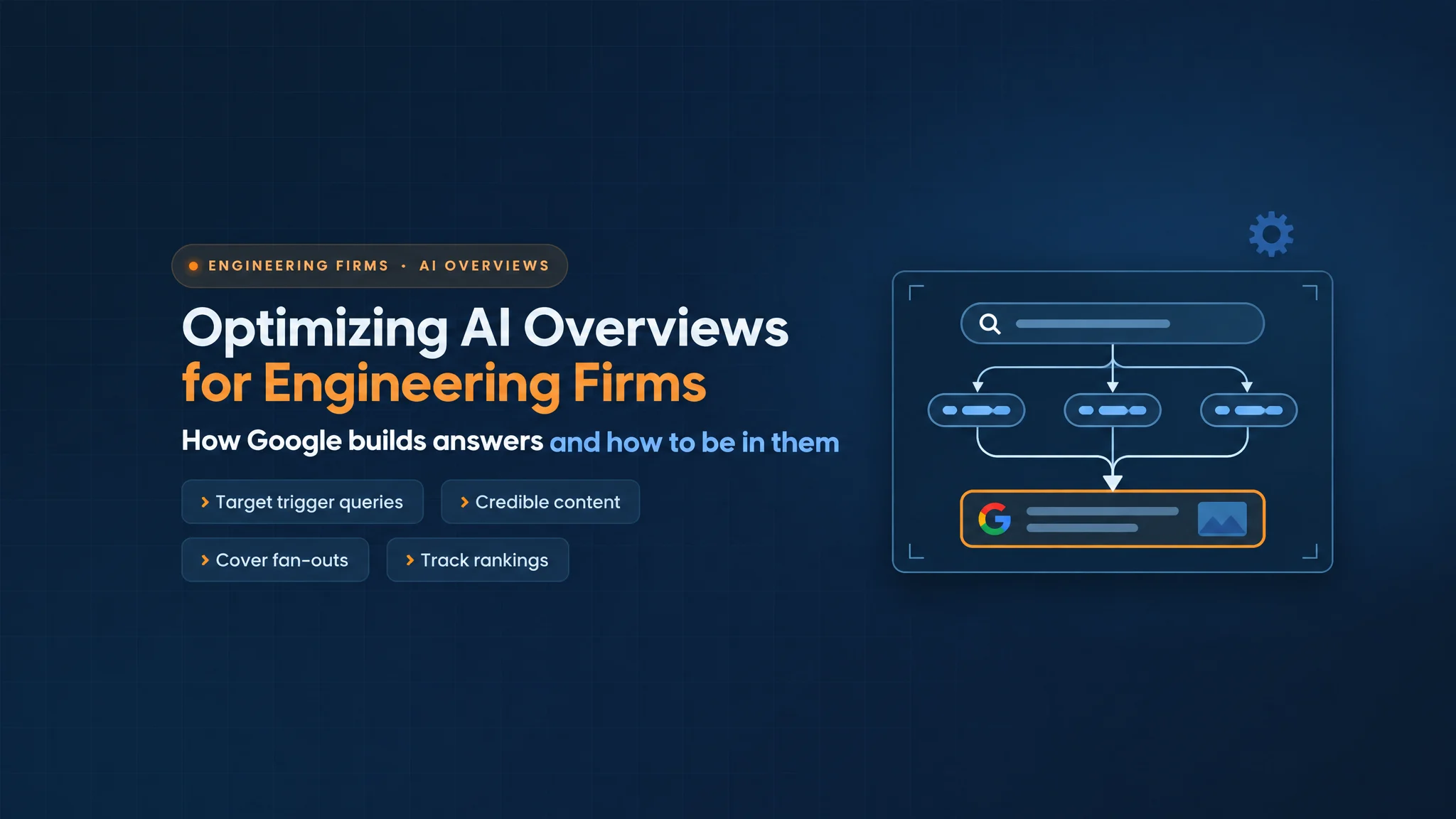
First, Google identifies what the user is looking for in their search. This query increases Google AI’s understanding of a searcher’s intent before it collects data for its summary. Algorithms use user data to rank results and better understand user intent. Then Google AI will collect from various sources to generate the summary. These algorithms use both public and private data to collect information.
Google then uses algorithms to rank and organize the information from most to least useful. Finally, include reference links to sources in order of priority. Overall, while SEO principles are still largely in play, you have far more to compete with to ensure your visibility and clicks are optimized in Google AIOs.
An In Depth Look At The Query Process
Below is a closer look inside the Query Process:
- What is a Query: A user types a question into Google, usually in the form of a “how to” perform, fix, or do something. Google uses NLP to understand generalizations like the object you asked about, “how to,” which is an ordered process, and user intent such as “fix” or “define.”
- Selecting Sources: Google searches its own data index to find related information from the phrases it picked out from your query. It also looks into information from closely related topics to your query. For example, if your how-to asks about fixing an object, it pulls information from professionals who understand how to fix it, plus related sources about the object.
- What is Triggering: Certain queries like how-tos are more complex than just a list of facts. This will trigger Google to prompt a more in-depth response in its summary.
- AI to Source Synthesis: Google will then generate a paragraph response with data from its selected sources and fillers from the trigger. The completed response would then walk the user through a step-by-step process or appear as a thorough enough response to whatever they searched.
- Adding Links: AIO will provide links to its sources and order them by what it deems most relevant to your query. Links and icons are visible and clickable, allowing users to visit the official websites of the sources it pulled from.
Strategies To Rank in AI Overviews
Target Queries To Generate Triggers
Target the type of query that triggers AIO responses. Optimize your SEO practice for AI by focusing on keyword length, character counts, content, word difficulty, and cost per word. Current guidelines that make up an AIO should follow these guidelines:
- Longer, More Specific Keywords: Three to five is considered optimal.
- Match Search Intent: Currently, searches are geared towards transactions rather than simply information.
- Optimize Keyword Difficulty: Current trends indicate a middle ground. Both low- and high-complexity keywords rank much lower in AI Summaries and visibility.
Ensure Credible Content
Credible human-focused content is still the top-ranked factor in AI citation, just like traditional search engines. Much like traditional SEO, you are writing content for humans while generating clicks that are optimal for the search engine. Follow EEAT guidelines to increase the likelihood that your sources always rank high in AIO:
- Experience: Experience proves hands-on use of a product, including building, repairs, and troubleshooting. Experience can also include hands-on knowledge and research on a topic.
- Expertise: Expertise, especially for higher-level skills like engineering, means having professional credentials that should be visible on your site to move up the ranks on an AI query trigger.
- Authority: Include public recognition, like positive reviews, of your product or service.
- Trust: Trust comes from consistently combining and proving the three above, backed by a proven track record.
Content Should Cover Fan-Outs
Ensure your content covers fan-outs. Fan-outs include the overall topic from the user's query and all sub-topics. These sub-topics are generated when AI separates key phrases from the initial query and then ranks them to collect more data in its search. Although the final AIO synthesizes all that information into one summary, you should also reference each sub-topic in your content. If a query asks “how to change a lightbulb,” sub-topics will split into “how much do light bulbs cost,” “here’s the nearest hardware store near you,” and “are you looking for delivery?” “What wattage should you use?” To optimize visibility, include keywords in your content that match the overall topic and each sub-topic.
Track Your Rankings
To stay ahead of the competition, track how your content ranks in both queries and fan-outs. Compare your content with other high-ranking pages and try to predict future trends. To stay ahead of trends, monitor which pages Google highlights most and identify a common thread. Current trends include creating bulleted lists, answering questions immediately in your content, and keeping your writing simple and clear.
You can use an AI Results tracker to show all AIOs that mention your content for qualitative data. This data will show specifics like what text is being quoted in AIOs. SE Rankings is a well-known ranking tool that will also show you when your keywords trigger AI but don't mention your site. You can then combine that information to optimize your content so triggers will result in AIO citations and clicks.
Key Takeaways
While a solid foundation in standard SEO practices is very important, AIO requires more attention to detail than just writing helpful content and adding FAQs. With experience in SEO writing, adding these extra steps will go a long way toward ensuring your content ranks at the top of Google AI Overviews. By understanding how AIO complies and summarizes queries, you can use these steps to optimize your content and track trends to keep your site at the top of Google AI rankings.