How Engineering Firms Can Run an AI Competitor Analysis in 2026
The growth of artificial intelligence (AI) tools has changed how engineers research and choose firms to hire. Before, engineering clients used search engines and compared multiple websites to research and decide which firms to turn to for products and services. But engineering clients now ask ChatGPT, Claude, Perplexity, and Google AI Overviews which firms to hire. With these tools, these clients can look at reviews, compare prices, and check your reliability all in one place. The problem is that only a few firms get named per answer, so you need to know who AI picks instead of you
The growth of artificial intelligence (AI) tools has changed how engineers research and choose firms to hire. Before, engineering clients used search engines and compared multiple websites to research and decide which firms to turn to for products and services. But engineering clients now ask ChatGPT, Claude, Perplexity, and Google AI Overviews which firms to hire. With these tools, these clients can look at reviews, compare prices, and check your reliability all in one place. The problem is that only a few firms get named per answer, so you need to know who AI picks instead of you
If you are looking for strategies for improving your AI visibility or are wondering how you compare against your competitors on AI platforms, this is the place for you. This guide covers competitive analysis for AI search engines and how to increase your visibility so potential clients see you when they're looking for your services.
What Is a Competitive Analysis for AI Search Engines?
Competitive analysis is the practice of identifying and understanding how you compare with your competitors in the same industry. In short, if you want to measure how your firm compares against rivals, running competitive analysis is essential. You can evaluate your competitors' strengths and weaknesses to find gaps and improve your positioning.
Another important, and increasingly popular, way to understand competitive analysis is through Generative Engine Optimization (GEO), or LLM visibility analysis. Unlike traditional SEO, which aims to push your website up a ranked list of blue links, GEO focuses on optimizing ways for you to get cited in AI-generated answers, which is important because only a few firms get named per response.
Core Metrics to Track
Before you run any analysis, you will need to find out what data points and measurements to look at to evaluate your firm’s health and performance. Some key metrics that will help you identify your visibility include the following:
- AI Visibility Percentage: This measures how often a brand is mentioned, cited, or recommended by AI search tools. This shows how often your firm appears versus competitors across repeated prompt runs.
- Prompt Set: A prompt set is a curated list of real-world questions and search queries used to test how often and how favorably AI search tools mention or cite a brand. You can use this for vendor searches, sentiment, market positioning, and brand accuracy.
- Sentiment and Positioning: Sentiment and position analysis measures brand perception and how customers feel in AI search engines. Use this to see how AI tools describe a brand's strengths and weaknesses and to identify best-fit clients.
Step-by-Step AI Competitive Framework for Engineering Firms
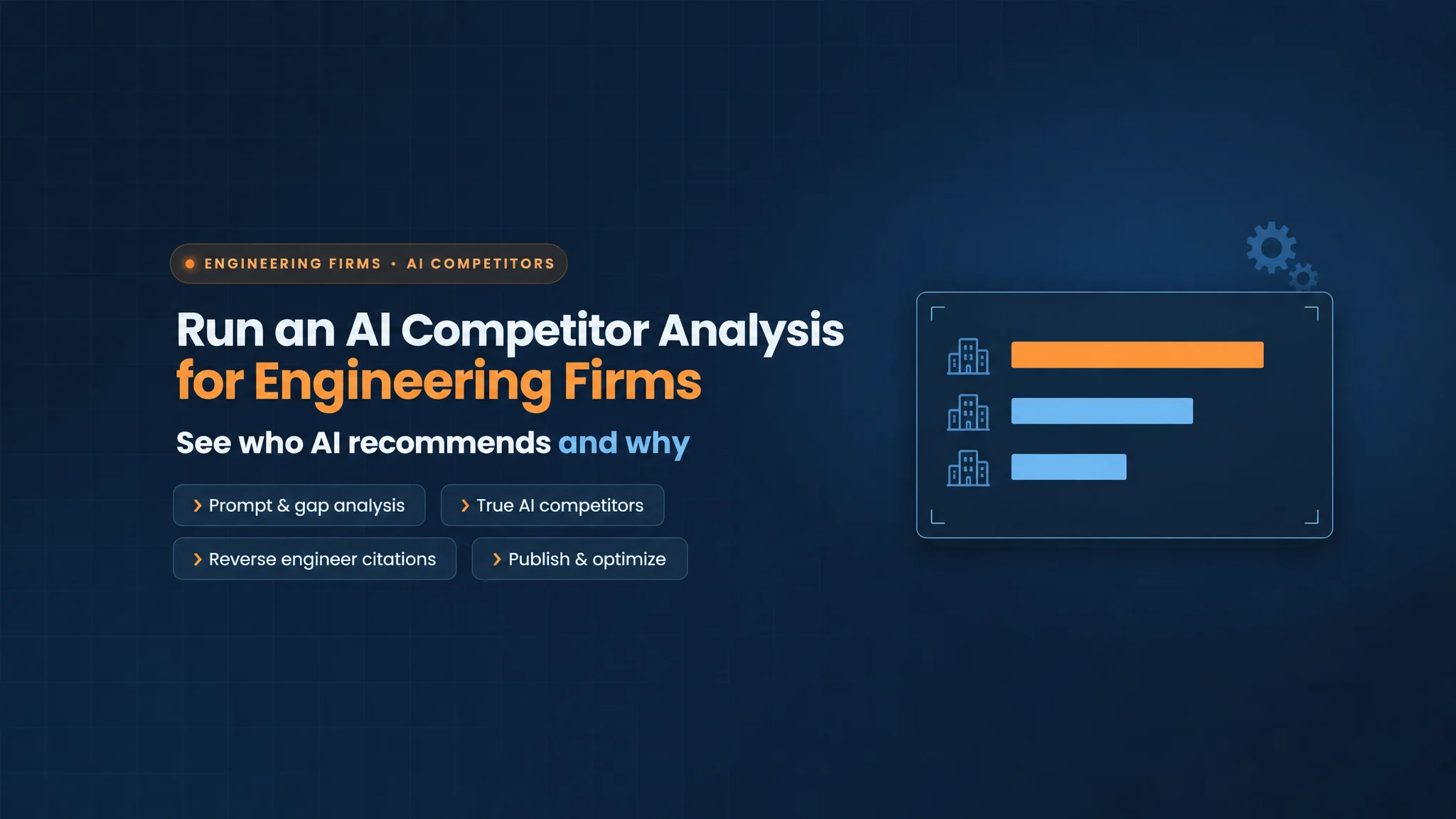
1. Run Prompt and Gap Analysis
The easiest way to see where you stand against competitors is to run prompt and gap analyses. To do this, compile a list of high-intent buyer prompts, such as "best civil engineering firms for municipal water projects in Ohio." Leave brand names out so the engine has to pick on its own.
You should run each prompt enough times so that one odd answer can’t skew the results. Additionally, when you run this analysis, track where competitors are cited and where your firm is missing. This will show where rivals outperform you in key, high-intent buyer prompts.
2. Identify Your True AI Competitors
Next, identify your true rivals. You can use tools such as Peec AI to see which firms are named in your searches. The main benefit is that it runs prompts against major AI engines, then reports how often a brand shows up in answers and how it’s described.
Run these analytics because they may reveal that your traditional rivals aren't the ones you see in AI search engines. You are used to understanding competitors through what you see in search engine results, like Google. However, some of your traditional competitors may not be investing in AI. By tracking your brand performance and AI visibility, you can see where you stand against brands that are actually investing in AI and who are included in key AI search engine results.
3. Reverse Engineer Cited Pages
After identifying the brands cited in key results, reverse-engineer those pages. And by reverse engineering, you should dissect what makes these pages rank so highly. Look for the search intent these AI tools prefer, the kinds of pages they want to review, and what they actually cite. If you identify a pattern, see why this happens. For instance, if you notice that AI search tools cite informational pages, then you’ll need to develop guides on your page that answer similar questions.
Another key area where you can find useful information is where queries fan out. Once you know the queries AI search tools make, you can optimize for them. You can use third-party tools that identify where AI search platforms take one single user query and expand it into multiple sub-queries to generate more comprehensive answers. You will gain useful insights into what queries LLMs searched for, how you can create content to comprehensively cover the questions your potential buyers have, and what LLMs cite.
4. Publish Relevant Content & Run Traditional SEO
Now it is time to optimize your page for AI search visibility. Through reverse engineering cited pages, identifying competitors, and identifying key user prompts, you should be able to get a sense of what content you need to have to rank highly on AI platforms. By creating reliable content, you can drive organic traffic for months or years, show your expertise in your industry, and provide AI search tools with authoritative content they must cite to provide comprehensive answers to users.
In many ways, you can build your AI visibility presence on the traditional SEO strategies you have been using. By performing SEO basics, such as having backlinks from reputable sources or ensuring that your page is crawlable, you will increase your AI visibility because both will get your brand in front of the right audience. Both AI visibility and traditional SEO require spending time to make sure your page is interesting to both machines and humans, and optimizing for one will pay dividends for the other.
Conclusion
The longer you wait, the more time your competitors will have to strengthen their position in AI visibility. Act soon so your business can keep growing and ensure your products and services reach the right audience at a crucial point in the buying experience. By performing competitive analysis, you can see where you stand against your competitors and where you need to improve. If you have questions or want to increase your AI visibility, contact Zupo.